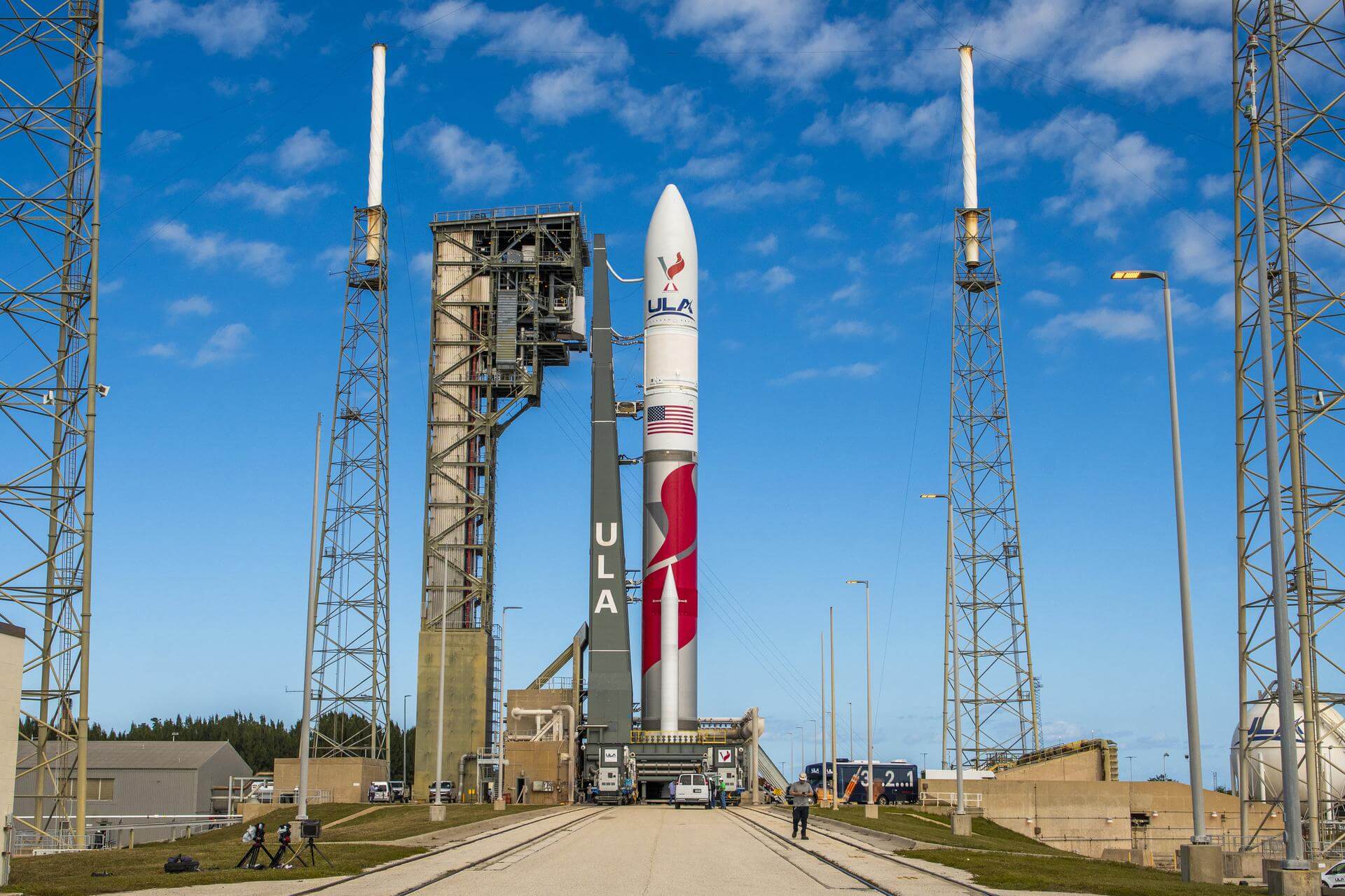
Vulcan | USSF-57
Read More expand_more
First of three Next Generation Overhead Persistent Infrared geostationary satellites designed for missile warning.
Mission Profile
Launch Date
May 31
2026
Time
00:00
UTC
Rocket
Vulcan
Vulcan
Site
ll-location-12
ll-pad-29
Orbit
GTO
Geostationary Transfer Orbit
history
Launch Timeline
expand_circle_down
Countdown Begins
Final vehicle activation and systems checks.
Tanking
Liquid natural gas (LNG), liquid oxygen (LOX), and liquid hydrogen (Centaur stage) begin loading.
Terminal Count
Final automated sequence begins.
Internal Power
The rocket switches to internal battery power.
Main Engine Ignition
The two BE-4 engines ignite and throttle up.
Liftoff
SRBs ignite and the hold-down bolts release.
Show More Events Show More Events expand_more
Max Q
Maximum aerodynamic pressure.
SRB Burnout and Jettison
Depending on configuration (2, 4, or 6 boosters), spent SRBs are jettisoned in pairs.
BECO
Booster Engine Cutoff: BE-4 engines shut down.
Stage Separation
Vulcan core stage separates from the Centaur V upper stage.
MES-1
Main Engine Start 1: twin RL10C engines ignite on Centaur V.
Fairing Jettison
5.4 m payload fairings are discarded.
SECO-1
Centaur reaches its initial parking orbit.
Deployment
Payload is released once precise orbital parameters are met.
Tank Venting / De-orbit
Centaur performs a disposal maneuver and vents remaining propellant, or de-orbits for reentry.
Mission Payload
First of three Next Generation Overhead Persistent Infrared geostationary satellites designed for missile warning.