Electron | VICTUS HAZE Puma
Read More expand_more
VICTUS HAZE will see Rocket Lab design, build, launch, and operate a rendezvous proximity operation (RPO) capable spacecraft. U.S. Space Force Space Systems Command (SSC)’s Space Safari’s VICTUS HAZE mission will be an exercise of a realistic threat-response scenario and on-orbit space domain awareness (SDA) demonstration. Once the spacecraft build is complete, Rocket Lab will be entered into a Hot Standby Phase awaiting further direction. Once the exercise begins, Rocket Lab will be given notice to launch the spacecraft into a target orbit. After reaching orbit, the spacecraft will be rapidly commissioned and readied for operations. Rocket Lab will configure a Pioneer class spacecraft bus to meet the unique requirements of the VICTUS HAZE mission.
The mission will improve Tactically Responsive Space (TacRS) processes and timelines, demonstrating the ability to respond to on-orbit threats on very short timelines and validating techniques for space domain awareness (SDA) and on-orbit characterization. Rocket Lab’s constellation-class production capability and discriminating technical capabilities in the areas of in-space propulsion, precision attitude control, low latency communications, and autonomous operations are key enablers for this mission.
Mission Profile
Launch Date
Jun 30
2026
Time
00:00
UTC
Rocket
Electron
Site
ll-location-10
ll-pad-210
Orbit
LEO
Low Earth Orbit
history
Launch Timeline
expand_circle_down
Auto Sequence
The launch computer takes full control of the countdown.
Ignition
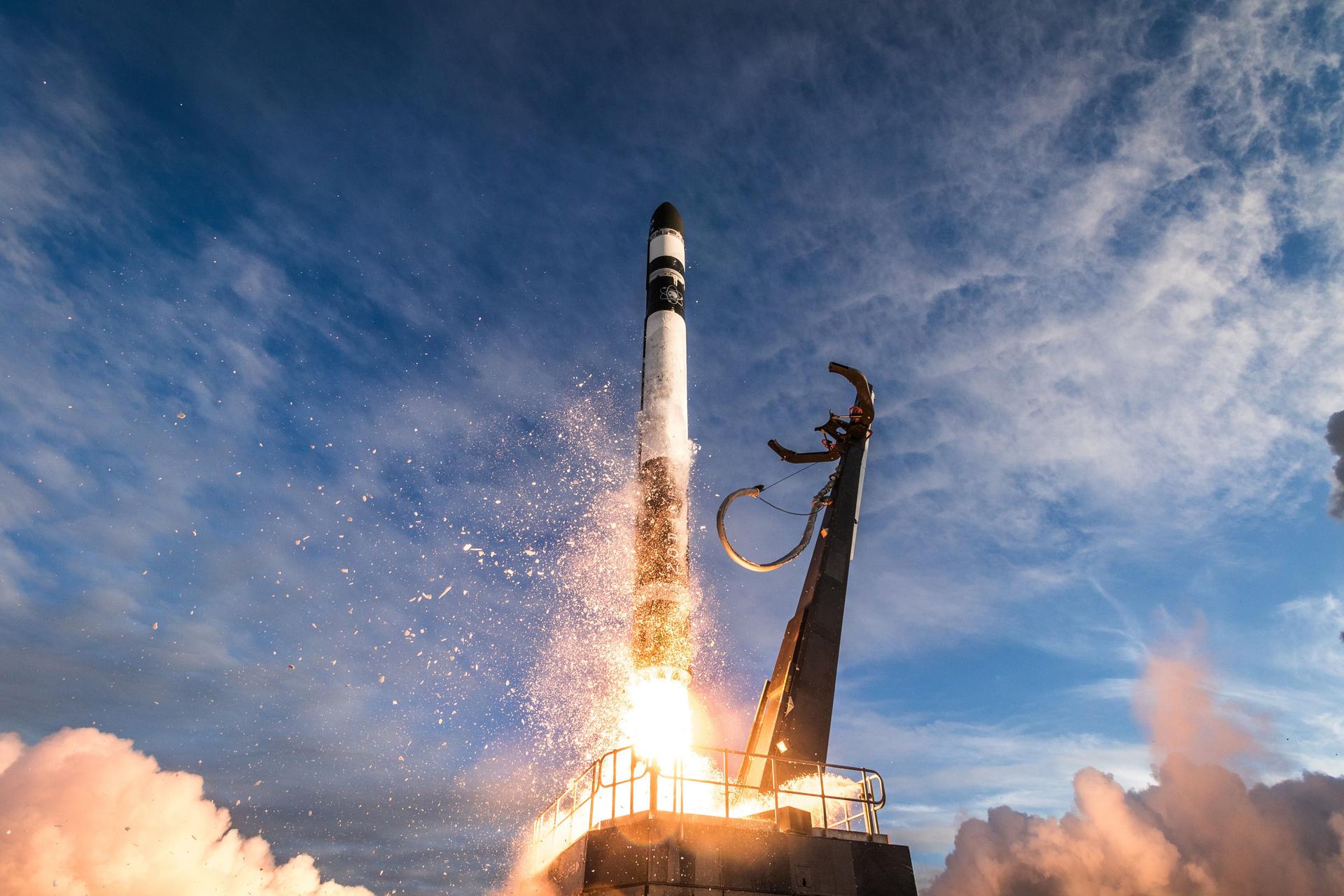
All 9 Rutherford engines on the first stage ignite.
Liftoff
Hold-down clamps release and the rocket clears the pad (Launch Complex 1 in NZ or LC-2 in Virginia).
Supersonic
The vehicle accelerates past the speed of sound.
Max Q
Peak aerodynamic pressure (maximum mechanical stress).
MECO
Main Engine Cutoff: first stage engines shut down.
Show More Events Show More Events expand_more
Stage Separation
Pneumatic pushers separate the first stage from the second stage.
Stage 2 Ignition
The single vacuum-optimized Rutherford engine ignites.
Fairing Jettison
The payload fairing separates.
Battery Hot Swap
Second stage batteries are jettisoned and the system switches to a fresh battery to complete ascent.
SECO
Second stage engine cutoff; the vehicle reaches a parking orbit.
Kick Stage Separation
The payload stack (Kick Stage) separates from the second stage.
Curie Engine Burn
The Curie engine on the Kick Stage fires to circularize the orbit.
Payload Deployment
Satellites are released.
Deorbit Burn
The Kick Stage performs a burn to reenter and burn up in the atmosphere.
Drogue Parachute
Drogue parachute deploys to stabilize the booster during descent (recovery missions).
Main Parachute
Main parachute deploys to slow the booster for splashdown (recovery missions).
Splashdown
Booster splashes down in the ocean for recovery by ship (recovery missions).
Mission Payload
VICTUS HAZE will see Rocket Lab design, build, launch, and operate a rendezvous proximity operation (RPO) capable spacecraft. U.S. Space Force Space Systems Command (SSC)’s Space Safari’s VICTUS HAZE mission will be an exercise of a realistic threat-response scenario and on-orbit space domain awareness (SDA) demonstration. Once the spacecraft build is complete, Rocket Lab will be entered into a Hot Standby Phase awaiting further direction. Once the exercise begins, Rocket Lab will be given notice to launch the spacecraft into a target orbit. After reaching orbit, the spacecraft will be rapidly commissioned and readied for operations. Rocket Lab will configure a Pioneer class spacecraft bus to meet the unique requirements of the VICTUS HAZE mission. The mission will improve Tactically Responsive Space (TacRS) processes and timelines, demonstrating the ability to respond to on-orbit threats on very short timelines and validating techniques for space domain awareness (SDA) and on-orbit characterization. Rocket Lab’s constellation-class production capability and discriminating technical capabilities in the areas of in-space propulsion, precision attitude control, low latency communications, and autonomous operations are key enablers for this mission.